

Writing for Non-Writers
Do you like the idea of writing for us, but don’t have the confidence or the experience? This article aims to change your mind!
And after you’ve written your piece, this article will give you some ideas on how to polish it up.
Vin’s Prompts
Playwright and friend of the project, Vin Adams, gave us some prompts to give your writing brain a nudge. What sort of a scenario might one of these suggest?
- A different kind of air.
- Dancing in the roads.
- The birds were there all along.
- Not a car in the world.
- Quite a few sounds from the pavement.
- At last, a fair hearing.
- Parking is such sweet sorrow.
- I could hear myself think.
- Side by side.
- When I was little, people used to have front gardens.
- Let the grass grow beneath your feet.
Getting Inspired by School Streets
You don’t have to be a child, or to imagine yourself as a child, to explore the fabulous topic of School Streets, where streets are closed to traffic during the school run. The first series of Pens of the Earth School Streets workshops took place this year at St John’s Cathedral Catholic Primary School, one of several local schools who are taking part in this experiment. In the autumn there will be more workshops and more local schools, and in 2023 we will publish the children’s own stories, poems and drawings.
However, as Jenni Jones says, “It would be interesting to explore how very differently people might experience the same street – the elderly vs teens, mums with buggies, men and women, day and night. There was a post recently where a man shared a photo of a train station at night and commented on how peaceful a place it was and lots of women posted that it looked terrifying!”
So we want your stories and poems too! You might be a mother, a teacher, a neighbour or a postman! You could be passing through, you could live on the street. Any perspective is welcomed.
To help you, we thought we’d share some of the questions we asked the children, and give you a flavour of the sort of things they noticed.
What people, animals, sounds and objects have you noticed in the streets around your school?
- People: talking, laughing, looking happy, helping each other, scooting, cycling, friends, community.
- Animals: birds, dogs, cats, butterflies, squirrels.
- Sounds: birds singing, silence, feet, traffic in the distance.
- Objects: leaves, clouds, plants, buildings, sun, trees, grass.
And here’s Jenni, sharing her own words about this: “We launched 3 more school streets across Hampshire last week and the atmosphere was what people talked about most – it’s more relaxing, it’s so lovely, everyone seems so happy, you can hear the children chattering …”
How might a road you know be different if there was no traffic on it?
- Did anything happen that made you laugh?
- Did anything make you think interesting thoughts or ask questions?
- Did anything surprise you while walking into school?
Developing a story:
- What might be the problem at the beginning?
- How might the characters try to solve the problem?
- What might go really well?
- What might go really badly?
- How might it end?
With thanks to our wonderful Pens of the Earth workshop leaders and designers: Christine Lawrence, Margaret Jennings and Vin Adams; Jenni Jones of Sustrans, and our local schools.
Links:
Annie Kirby on Sensory Details
Annie talks about using sensory details in your writing:
Annie’s debut novel The Hollow Sea is available from 18th August 2022.
Sue Shipp on Dialogue
Pens of the Earth editor and contributor Sue Shipp talks about how to use dialogue to get across a positive environmental message by analysing her short story Every Little Helps.
Sue’s stories have been published by Portsmouth News and Star & Crescent, and performed by The King’s Youth Theatre (Save Our Seas showcase).
Denise Baden
Denise Baden is Professor of Sustainable Practice at the University of Southampton and the founder of Green Stories. Here she talks about the effectiveness of fiction to inspire environmental change:
School Streets
Last year, Jenni Jones of Sustrans introduced us to School Streets for our #SmallDifferencesAddUp theme and Tina MacNaughton featured them in her story Mrs Peters.
Jenni sparked a whole new Pens of the Earth adventure when she challenged us to get children to describe their traffic-free journeys to and from school.
Christine Lawrence is in charge of taking these workshops into schools, with assistance from other Pens volunteers. Here is her personal account:
“Almost a year ago I volunteered to take part in this project after meeting with Jenni Jones, the Liveable Cities & Towns Officer for Sustrans, on a Zoom meeting for Pens of the Earth.
Jenni explained, ‘A school street is where a road (or section of road) outside the school gates is closed to motor vehicles and becomes a pedestrian and cycle zone at drop-off and pick-up times. It’s a place where many people making small changes can totally transform the environment. In a School Street, so many people go the extra mile and the result is a healthier, happier, safer place for everyone. Above all it’s about the children, free from the stress of negotiating traffic, free to just run and play and do what kids do.’
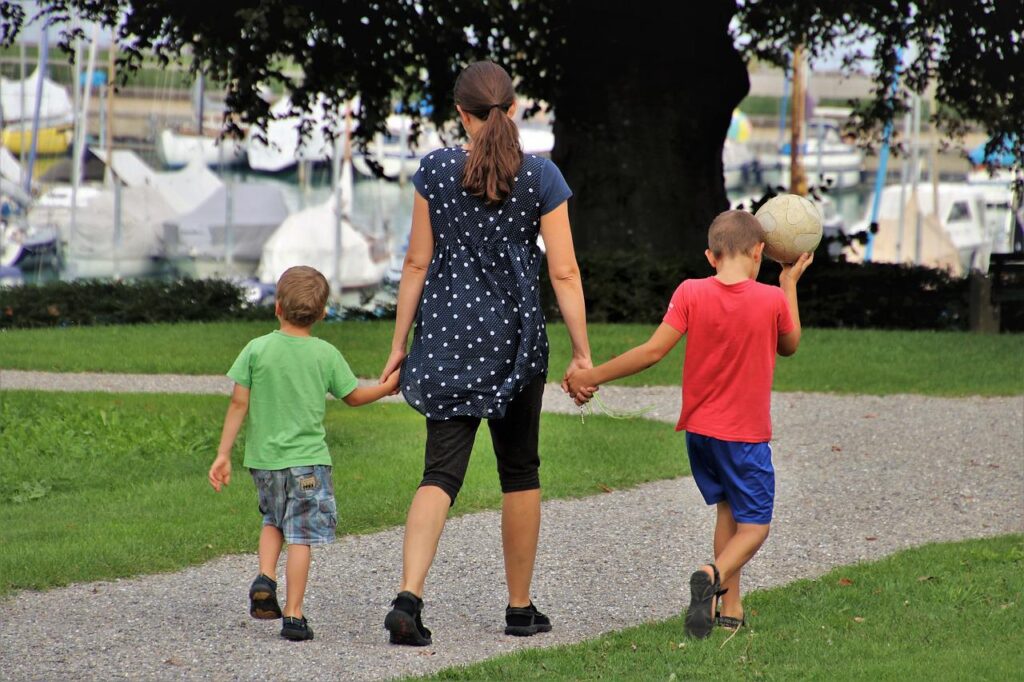
After meeting with head teachers and their supports, we went into the first school in May this year and ran workshops with ten pupils who explored the differences noticed on their school journeys, making up stories of what they had observed. They looked at what message they would want to give to the world and we discussed the benefits of walking, cycling or scooting to school.
The plan was that we would hold three workshops; the first to introduce the project and to get the children thinking and sharing their thoughts of how School Streets could benefit them and the community. We gave the children worksheets to take away, with ideas on how to put together a story or a poem about their experiences. We encouraged them to use all of their senses to notice the world around them and to describe what they experienced about their journeys.
The second workshop was planned to be a few weeks later, with the school’s support teacher meeting up with the children weekly to enable continuity for the group. We encouraged the children to share what they had experienced. Was there anything about the journey that was funny or surprising? Did anything happen on the way?
We asked them to explore potential stories or poems and talked with them about the structure of stories and poetry. Each child shared what they had written – some had jotted down ideas in their notebooks and on their worksheets, others had already written a complete piece. We encouraged them to illustrate their work and discussed how they might share their work with the wider community.
The third workshop was to be a showcase. Each school had different ideas of how to share the work. Some were keen for the children to present their work to the school in assemblies, others preferred to have the work shared on screen by being videoed, or shared in small classroom settings. All of the children were excited to have their work published on the Pens of the Earth website and this has been supported by the schools.
It’s still early days. We will be continuing with this exciting project into the Autumn term and look forward to sharing the children’s writings later this year on our website.”
Schools that are taking part in the project are:
- St. Johns Cathedral Catholic Primary School, Cottage View, Portsmouth
- Meon Junior School, Shelford Road, Southsea
- Kings Academy Northern Parade, Doyle Avenue, Hilsea
- Kings Academy College Park, Crofton Road, Portsmouth
Twenty Minute Neighbourhoods
The idea of a 20-minute neighbourhood is a place where people can easily and safely walk and cycle to most local amenities via a short, convenient and pleasant 20-minute return journey.
Thanks to Jenni Jones of Sustrans for sending us this film clip of a new development on the outskirts of Cambridge which has been has been designed as a low-car community, centred around boosting quality of life for everyone.
Creatively Interpreting Our Themes
Some thoughts on writing from our founder, Helen:
Pompey Parklets
Jenni Jones of Sustrans talks about Pompey Parklets:
“For the last 50 years or so, our towns and cities have been designed to accommodate vehicles. With little thought for pedestrians, less for those with mobility issues and barely a nod to cyclists, vehicles began to squeeze us mere mortals out of the public realm. People were marginalised to make room for yet more traffic. As much of Europe continued to accommodate all kinds of travellers, the UK pushed ahead with out-of-town shopping centres and car-dependent housing estates. With public transport also leaving much room for improvement, it’s really no wonder that we have become a society so utterly dependent on private cars.
But the good news is that the tide is turning! Finally, we have a government willing to invest in active travel, new planning guidelines designed to protect and value people walking and wheeling, and a renewed passion for getting around under our own steam. Boosted by the time we spent locally during the pandemic, virtually traffic-free and reconnecting with nature on our daily walks, we have experienced a different way of being and we want to hold onto it.
In Portsmouth, PCC has already declared a climate emergency and the Transport Plan sets out the vision that ‘By 2038 Portsmouth will have a people-centred, connected, travel network that prioritises walking, cycling and public transport to help deliver a safer, healthier and more prosperous city.’
But, we know that getting people out of their cars is about more than building better cycle lanes.
We have to make places that are more attractive for people to walk and cycle, create places where they feel safe and actually want to spend time. Neighbourhoods where children are able to play outside, where the elderly can cross the road without fear, where shops and schools are just a short walk away so we no longer need to drive everywhere, every day. We need secure bike parking, greenery, seating, toilets and spaces to socialise – we need liveable streets.
Cue Pompey Parklets – a bold and exciting project destined for Albert Road and Highland Road. These specially designed mini-parks will be a breath of fresh air, and we can expect to see more of them popping up across Portsmouth in the next few years.
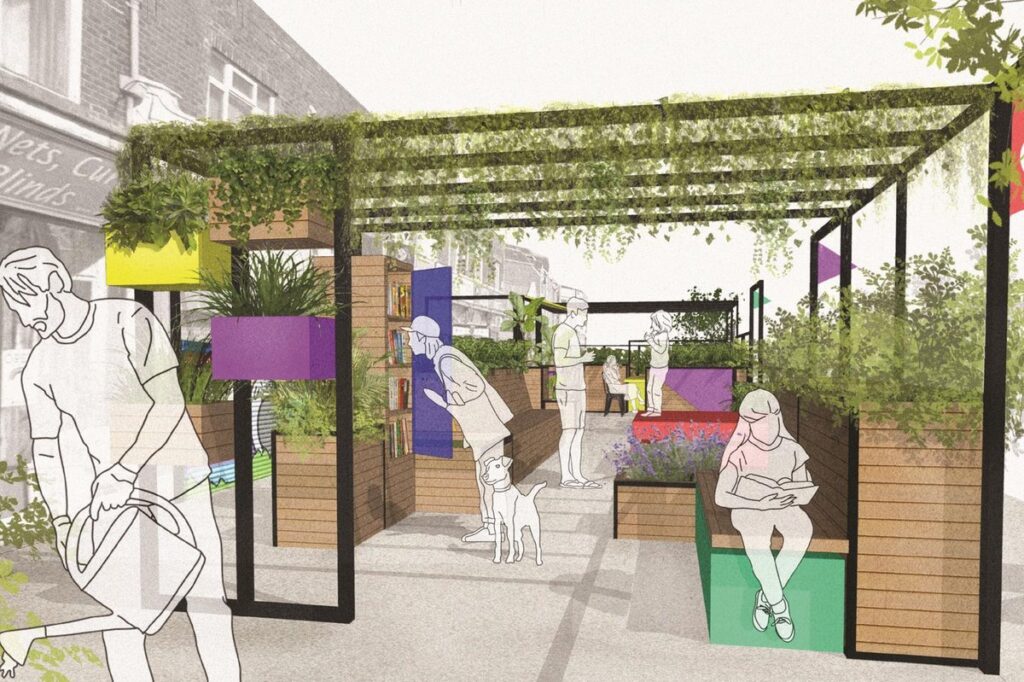
Each parklet will be a social space, a wildlife haven and an active travel hub. With seating, bike racks, planters, bird and bat boxes and much more, they will be buzzing with all kinds of life. A place to stop, rest, share a coffee with friends, read a book, and revel in this small but perfectly formed urban oasis. Lovely even to walk past, they will add a welcome splash of colour and life for everyone to enjoy.
Sustrans has helped to deliver lots of parklets and liveable neighbourhoods over the last few years. We know that when you create spaces for people in high streets footfall increases, average spend increases, more people choose to walk and cycle and social isolation is reduced because people have a space to socialise and just BE. When these projects are done right, led by ordinary people who want to make their communities better for everyone, everybody wins.
A competition to design the parklets was launched in 2021 at the University of Portsmouth. The winning design was by 2nd year Architecture MA students Charlotte Hubbard and Jack Clark. The designs are modular, meaning it can be custom designed to meet the needs of different communities. For example, more seating areas outside cafes, more space for cycle or pushchair parking, shade and shelter or even mini libraries. At both Albert Road and Highland Road, the Pompey Parklets team worked closely with businesses to make sure the final design suited them perfectly.
Having raised nearly £35,000 in funds, including an incredible £8000 through crowdfunding, the parklets should be in place in August this year.”
Lists
We’ve created two lists of exciting local and national environmental initiatives. Here’s the one for our Making Places for People theme. (The one for the Life Under the Surface theme is here.)
You don’t need a Twitter account to view these lists. Just click on these links and scroll down to view the latest information.