

In deciding to publish a printed book of our work there has been much soul searching for me, as Pens of the Earth founder.
Is this a good use of our planet’s scarce resources? I’ve asked myself a number of times.
Is what we have to offer so vital? I’ve pondered deep at night when I should have been sleeping.
Ultimately, I’ve come to the same conclusion over and over again: ‘Yes!’
This is why. I hope you agree.
Is what we have to offer vital?
Our message of positive environmental hope – sharing initiatives and ideas – is vital. All too often what is seen and shared is the bad news, the things which can make people feel helpless, hopeless, powerless to act. When I started writing articles about local green initiatives, what struck me was the excitement of finding out how many dedicated people were working to make a difference, to provide hope for a future generation, hope for wildlife, hope for our planet.
Long before the idea of Pens of the Earth first came to me, I wanted to jump on the rooftops and tell everyone about it, but because I’m a writer, that became ‘write about it’. That’s where my skills lie. That’s where the skills lie of every writer who has contributed stories and poetry, who has volunteered with Pens of the Earth to help inspire other writers, to help select, edit, hone and promote the stories and poems we tell.
As Andy Ames of Hampshire and Isle of Wight Wildlife Trust says:
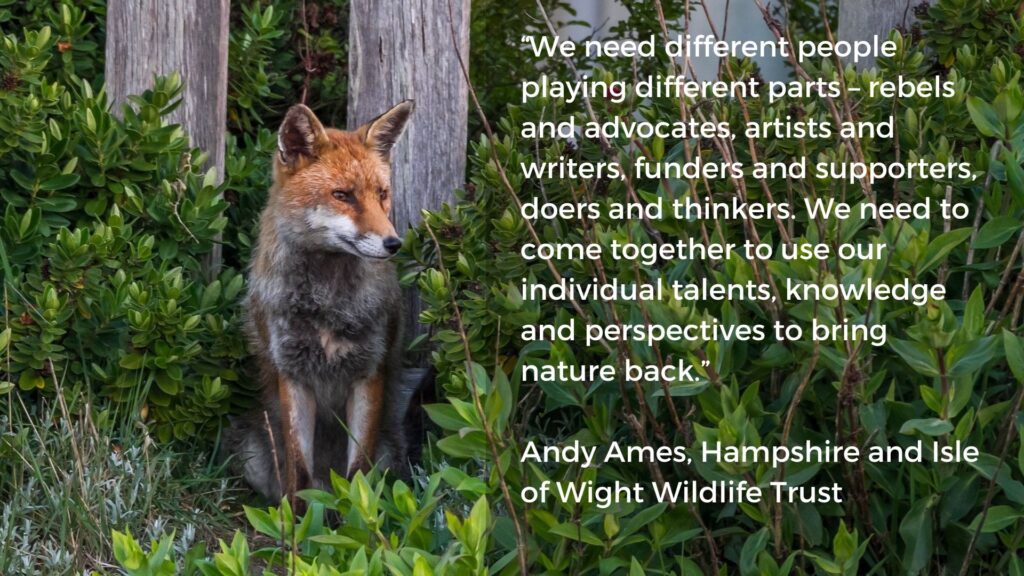
The health of our planet is something we all have a role in fighting for.
So, yes, I believe it’s vital.
Is this a good use of our planet’s scarce resources?
Years ago, I interviewed Christine Seaward, CEO of the South Downs Sustainability Centre. It was an inspirational interview, one of the many quotes I brought away from the interview was:
‘We cannot be … no impact. So what we need to do is be mindful and informed of the impact we’re having.’
It became very much the ethos of Pens of the Earth. No decision to use resources was made lightly. At our launch we asked people to bring their own mugs, so we didn’t need to use the plastic cups normally provided by the venue. For years, we didn’t have a bank account – let’s see how far we can get without spending money! We got a long way! We always sought to consider sustainability and the environment in the choices we made.
In addition, our website is hosted by EcoWebHosting (our only real expenditure) who use 100% renewable energy and plant trees for us every month.
When it comes to fundraising to publish our book we’ve taken the following actions and considered the following:
- Paper book versus online screen time: This is an ongoing argument. Just because we don’t see the resources used in our screen time in the same way that you can see the physical resources which go into publishing a book, it doesn’t mean that they aren’t being used. According to Nicola Peel we need to step away from the resources which come from below ground, and which ought to stay there, and concentrate on the more natural ones – such as trees, for instance. Here’s what she has to say about Facebook and Smart phones.
- Paper is not just recyclable, it’s also compostable. We need to prevent deforestation, but that doesn’t mean that ethical harvesting and replanting of trees is necessarily bad for the planet.
- People like paper books. They read them in a different way. They can hand them to friends, they can share them with family, they can sit in libraries, and have a second life in a charity shop. One book could reach many people. And once it’s printed – that’s the whole carbon footprint.
- The book will be printed on Holmen Bookwove paper. You can learn more in Holmen’s video about how the environment and sustainability is considered throughout their process, including planting two trees for every one they fell, and turning sawdust and bark (which can’t be used to make paper) into biofuel. You can also view their sustainability awards here.
- By offering environmental rewards and competition prizes, our fundamental ethos of raising awareness and empowering people to act can still be prominent even when fundraising.
- We are running a sponsored litter pick. We’re indebted to Christina Moran for this one – we love the balance of environmental action and awareness-raising.
- All our profits go to seagrass restoration, which helps protect the planet.