

Danecroft Otter
by Judith Thompson
Phew! What an adrenaline-rich day. Everyone has ordinary days, but since finding our forever home at Danecroft, in Suffolk, 26 years ago many days are extraordinary.
Our life here is like living at a film location. This is a magical 9.5-acre place; a rare mosaic of forgotten habitat untouched since the second world war. Dry and wet woodland, derelict water meadows and small grassy glades lie within a flood plain. Diverse tall plants – sedge, butterbur, purple-headed reed – co-exist without dominance, each suited to different areas and conditions. 2000 years ago this was swamp land; 200 years ago it was farmed for hop, then for willow osiers; 77 years ago, it became war-time abandoned land. Rattlesden river is ever the constant, meandering through, connecting water to land like sea to sand.
‘What’s that?’ Steve shouted out.
I dashed to the bedroom window to see a lithe shape, repeatedly leaping, looping and bouncing as it headed for the log store. 7am on this murky March morning; it looked so small, squirrel size but not squirrel-like. It dashed through the electric fence.
‘Oh dear, that may have injured it.’ Steve kept watch while I grabbed binoculars. We mirrored each other’s thoughts, ‘could it be an otter?’ We both ran.
Our land follows the contours of the river, as it reaches out towards rolling clay hills and fields with less tree cover. Our neighbour’s fields also follow the river’s course, and make their own unique contributions to this green, wildlife-rich corridor sandwiched between two minor roads and close to our expanding market town.
We scanned and searched with pumped up hearts, hoping ‘Bounce’ was unharmed and knowing we needed to seek help if it was.
‘Squirrel, otter or mink, what do you think?’ I asked as we hunted in vain.
Since early childhood, in different home towns, we both fell in love with nature. We act as guardians of this land, our footsteps tread lightly through time and we retain a childlike sense of awe and wonder.
We knew otters had been seen up and down the river valley. But as they are such secretive mammals we had never been fortunate enough to encounter them, even though we had seen fish scales and fish bones around the edge of our wild pond over the years.
Living in our green, nature-filled world lifts our spirits every day. We are happily distracted when routine tasks are punctuated with glimpses of wildness. Snake in the slipper, kingfisher dipper, water vole, buzzard, red kite, rare moth, stag beetle, buzzard, toad, great crested newt, butterfly or dragonfly, yet never an otter.
Our landscape projects aim to maintain, protect and enhance nature on our doorstep, to add value to wildness. We connect to neighbouring green nature spaces creating a rich, rare habitat tapestry running through the valley. Sustainable biodiversity is rooted here and spreads out into open countryside.
After breakfast, feeling uncomfortably anxious and downhearted, we headed to our smallholding ‘patch’ where geese, hens, ducks and mischievous goats have their own space.
It was while feeding our goats that Steve heard a high-pitched squealing. In stormy, strong wind this was amazing. ‘It must be Bounce trapped and calling for help‘.
A plan was hatched. Steve tuned into each squeal, while I raced for a fish landing net and a box with air gaps and lid – just in case.
‘Listen, that is definitely coming from the log store.’
The squeals stopped as we arrived. We kept very still. ‘You start from the left, I’ll start from the far side,’ Steve whispered.
We scanned every nook and cranny, looking deep into the dark corners. Our search was slow and steady. Heads not moving; eyes wide open.
I was getting hot with the effort of concentration and then a shock line ran down my spine. Eyes met wide-open, staring eyes.
‘Steve,’ I whispered, ‘Bounce has reversed into that box of logs. Put the net over the front.’
United in effort, working silently, we moved forward. At the same time, Bounce reversed, keeping those bright eyes on mine. Deftly, Steve cleared enough space to flick the net across the open front, then with a fast snatch Bounce was transferred into the container and its lid snapped shut.
‘Now what?’ We froze for a fleeting moment. ‘What is this, so tiny, so alone, we are out of our comfort zone?’
Phone calls to the RSPCA and a visit to the vet saved the day. Fear melted into relief, relief roared into amazement, amazement relaxed into disbelief when the vet opened the box and a calm, helpless otter kit looked up.
*
Since the kit was not injured, and following the advice of both vet and RSPCA, the young otter returned with us to Danecroft and was released in the hope of reuniting it with its mother. Within minutes of opening the box it disappeared into the logs where we originally found it. We left food and water nearby.
Steve and I worried that if the mother and kit were not reunited this beautiful, young wild animal would not survive the night. Yet we knew we had to stay away for a few hours to give the reunion its best chance.
We had arranged to give a progress report to Stow Vets in the late afternoon and we were not looking forward to telling them there’d been no sign that the mother had returned. Full of doubt at this stage, we thought it may have been better to have left the kit for the RSPCA to collect from Stow Vets.
So we decided, before darkness came, we had to search and rescue the kit if at all possible. To minimise human disturbance, Steve decided to take down a few fence panels to provide a better view of the back of the log store. He went to our barn, about sixty metres away, to fetch tools and stopped in his tracks when he saw the kit again moving in and out of the electric fence nearer the river and heard it making high pitched squeals.
Once again, we sprang into action to fetch the landing-net and box. We both agreed this was the one chance we had to ensure the kit survived. The safe environment of the RSPCA wildlife centre in East Winch, Norfolk became our goal. Quickly and carefully we covered the kit with the net and put the box over it. Steve phoned the vet, who called the RSPCA. When under the box, this little kit was so very quiet we were unsure if it was alive.
On her arrival, an hour later, the RSPCA expert lifted the box away from the kit and skilfully transferred it, unharmed, to her carry box. The kit moved cautiously around but was clearly uninjured. The RSPCA think the mother otter deliberately pushed this youngster out of the holt as perhaps she had too many to rear. We all felt very sad that it had not been reunited with its mother, but extremely reassured that it was now going to be cared for until it was old enough to be released back into the wild.
That night we reflected that our day was hugely memorable, stressful yet magical. We renamed Bounce ‘Magic’ and marvelled at this encounter.
*
Six months later Steve took a phone call. ‘You won’t believe this,’ he remarked. ‘Magic is coming home; if we agree.’
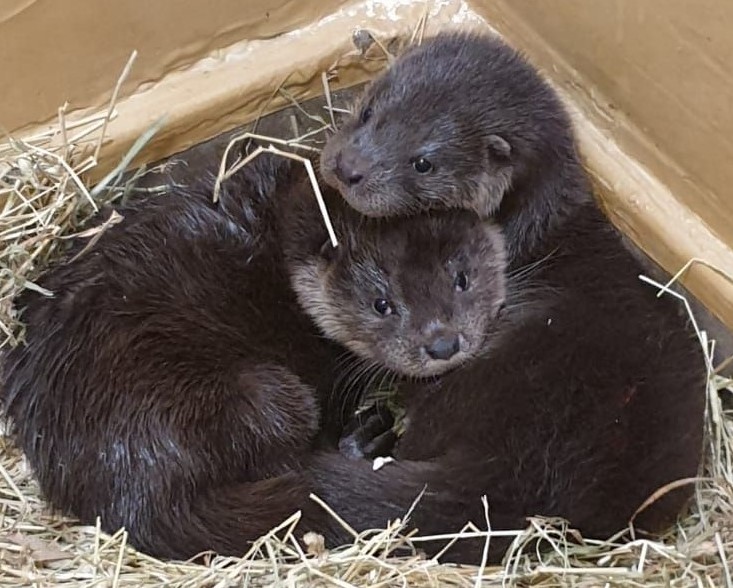
The kit had survived and thrived at the otter sanctuary, and amazingly buddied up with another otter the same age. Both were ready for release.
Otters require clean rivers with an abundant, varied supply of food and plenty of bank-side vegetation offering secluded sites for their holts. They particularly like wetland and marsh areas for raising their young.
Our Rattlesden River Special Landscape Area was the perfect habitat, providing appropriate cover along the tranquil river with minimal human disturbance.
Both otters were ready for release. Would we have them?
Excitedly, we said yes.
Following discussions around release location and timing, a transit van arrived at dusk on a calm evening in late September. A few friends joined us to witness this momentous occasion.
A boggy pond area we call the beach was the perfect release spot. As darkness fell, we waited and watched in silent anticipation. A single spotlight shone nearby, as two large crates were carried to the beach, straps unbuckled, bolts unclicked, first one door opened then the other. We waited and watched, we watched and waited.
‘Look over there!’ A long shadow-like body was slithering through the door, slipping silently under the pond’s surface. Gone.
We waited.
‘See in the far corner, upright on two legs.’
The second full grown otter dropped down onto the box floor, before creeping out of the door, then gracefully along the beach until it disappeared into the moonlit water.
Footnote: Such is the rarity of otters they are a priority species in the UK Biodiversity Action Plan and are classified as Near Threatened on the IUCN Red List (2004). They are fully protected in the UK under schedule 5 of the Wildlife and Countryside Act 1981.
Video: You can see one of the otters being released here:
Inspiration: I wrote this following the magical encounter my husband and I had with an abandoned otter. We are fortunate to own 9.5 acres of land. We knew otters visited the river and pond from time to time by the evidence of fish scales, tracks, and spraint. Having this close encounter with such a small, isolated, frightened, wide-eyed, wild animal was a heart-stopping experience which led me to record the otter events as they unfolded during the day.
Photo by RSPCA East Winch Wildlife Centre, Norfolk
Throughout her professional life Judith has been involved in education in many different guises, with a love of supporting others – young and older, of all abilities – to believe in themselves and to discover their strengths and talents. For the last 26 years she has lived in a quiet nature place that is full of wonder. She is a creative campaigner, eco activist, project volunteer and – her favourite job of all – a land girl working alongside her husband to protect, preserve and enhance their tiny patch of land for the short time they act as guardians of it.