

By Tom Sykes
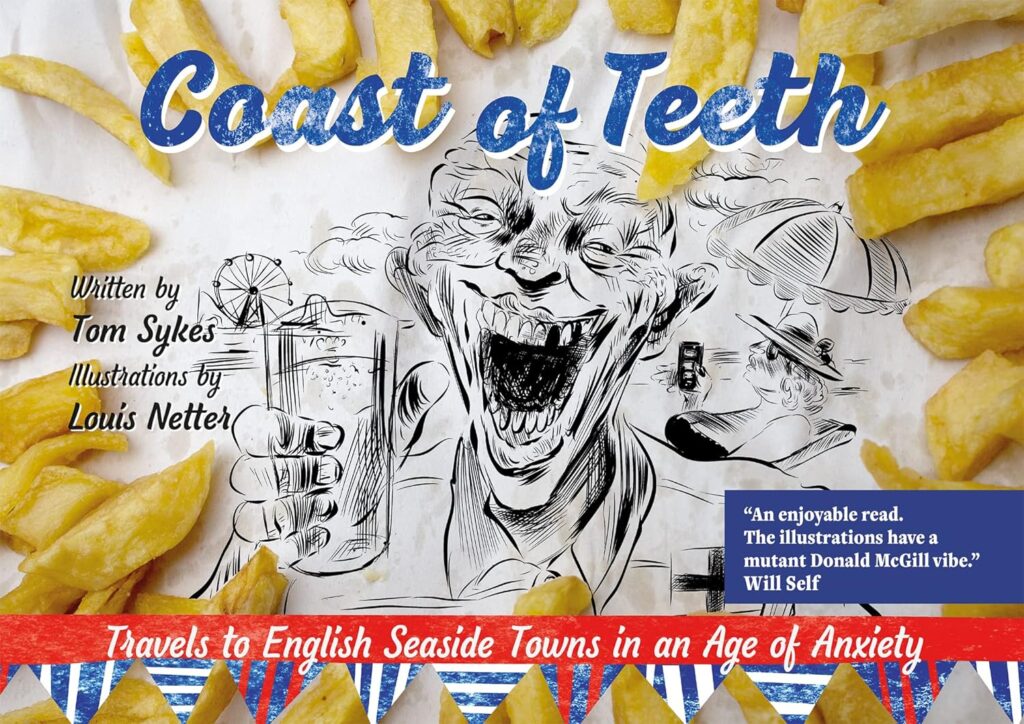
Over the course of researching our book Coast of Teeth, my illustrator colleague Louis Netter learned much about the ecological perils facing the English seaside. Surging sea levels are triggering floods and toppling homes. Cruise liners, commercial ports and military-industrial concerns are puffing masses of carbon emissions into the atmosphere. Sewage is being dumped on our shores by an unscrupulous company that should have treated that same sewage. There has never been so much plastic pollution along the English littoral. As eyewitnesses to these scourges, it would have been easy for Louis and I to have lost all hope about the fate of our planet.
But we didn’t lose hope. More than that, we became optimists, since on our travels we also saw wind turbines generating renewable energy on the Essex, Sussex, Devon and Dorset coasts. We saw the cultivation and protection of parks, woods, allotments and community gardens in Scarborough and Clacton and Bournemouth and Southsea.
In the sombre, conical Jaywick Martello Tower arts centre we were privileged to see grassroots projects that have united local photographers, painters, musicians, historians and schoolchildren to creatively respond to the theme of flooding and curate an exhibition of beachcombed items from flippers to crabbing nets. This in spite of the local MP being a climate change sceptic.
We shadowed my good friend and colleague at the University of Portsmouth, Dan McCabe, one of a rising number of beachcombers helping to clean our shores. ‘If we find plastic we pick it up and put it in the bin,’ he said as we trudged the green seaweed-carpeted shingle of Langstone Bay on a steaming June day. ‘A lot of people’s activities take place on land and others, like sailors and surfers, operate in the sea. You hope they respect their environments. Beachcombers inhabit the space between land and sea and we have to respect it.’
On September 15th 2018, Dan was one of hundreds of thousands of people who gathered 20.5 million pounds of waste from the coasts of over 100 countries. Such initiatives, along with volunteer ‘beach cleans’ across the UK, are pushing back against pollution.
Dan is a fan of nature’s resilience and creativity. At one point on our trip he reached down to a thing of beauty that my untrained eye had missed. It was a perfectly smooth, silvery triangle of glass. ‘Sometimes the ocean fashions something that seems like it’s been crafted by a human,’ he said. ‘This looks so good because it’s been washed and bashed and contoured for who knows how long.’
Nature also aids beachcombers by, as Dan put it, ‘sorting objects out by size and weight. The waves will transport the lighter things higher up the beach. The heavier, often more interesting stuff will be nearer the water.’
There are many people across the country like Dan who are quietly helping nature in return. The hope, surely, is that enough others will do the same before it’s too late.