

Portuguese Man o’ War
by Christina Moran
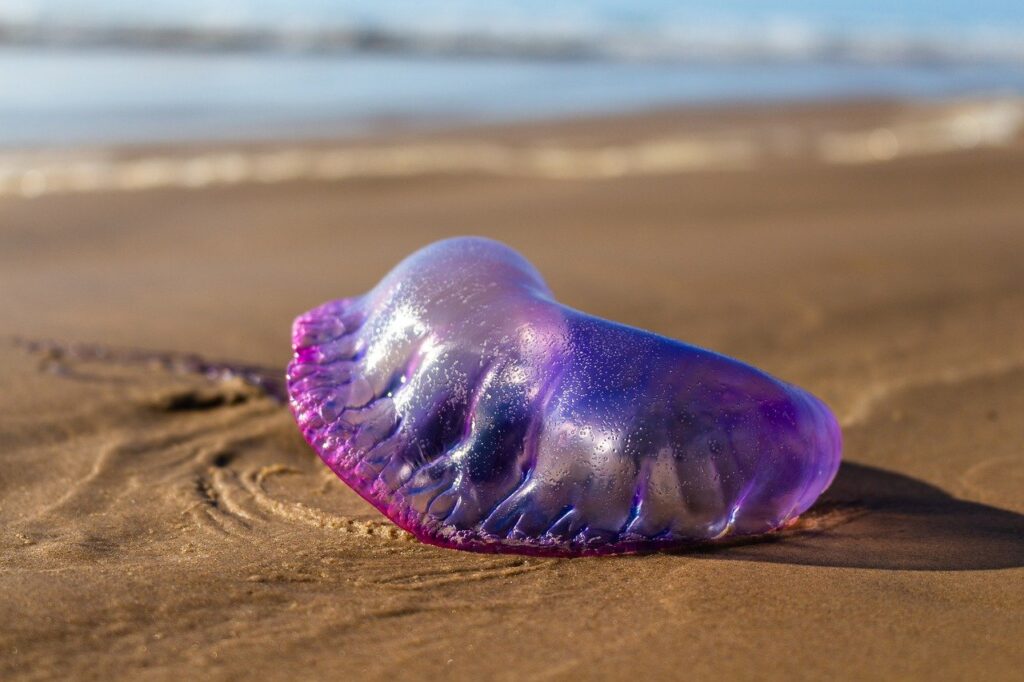
To Samoa, Kilkee, Galveston, South Avalon,
Newquay, Tiree, Bonchurch, and Tresco,
to all these shores and more, gelatinous
bladders of gases, balloons of rainbow
blob, with crested sails like crimped glass,
arrive on a random tide, tempest-blown,
current-driven, to lie perkily on a beach,
as sweet to look at as a soap sud bubble.
And their sibling parts, the gene sharers
and key group members, the terrible
tentacles with venomous barbs and wires,
where are they? Maybe clumped beneath,
coiled alongside, or floating somewhere,
strings of indigo, caerulean, and turquoise
blue, clone troops, leaderless, half-dead
but still heavily armed and dangerous.
But all to no point. Without old comrades
and companions, their prey-dissolvers
and digesters (gastro-heroes, the gut-
bags and mouths that hang beneath
the inflated floats), the tentacles’ poison
and stretchy fishing hoists are not enough
to go it alone. They’re doomed. But one
key task in life’s battle plan is to mate.
Either a Man O’ War or Woman O’ War,
the creature, the colony, the whole team
is one sex, and has a special crew to make
either sperm or egg. The water column
ensures what comes next: the Atlantic
and other seas spawn new siphonophores.
The Man O’ War’s not an animal. It’s a They,
not an It but multiple zooids, the existence
of each dependent on the others- a union
astounding in complexity and persistence.
For millions of years this drifting galleon
of cells has been setting its sail to the sky.
Image by Sergio Serjão from Pixabay