
The Mother Duck and the Drake
by Linda Hilborne
The brown mallard hen plunged her head under the water and pulled her beak through the mud at the bottom of the pond, to sift it for food.
She hoped there would be no sticky food wrappers today. They interfered with her movements and stuck to her beak. They stuck to the creatures that lived in the mud, which she was trying to eat. The food remains on the wrappers went nasty quickly in the water and made the pond clouded and dirty.
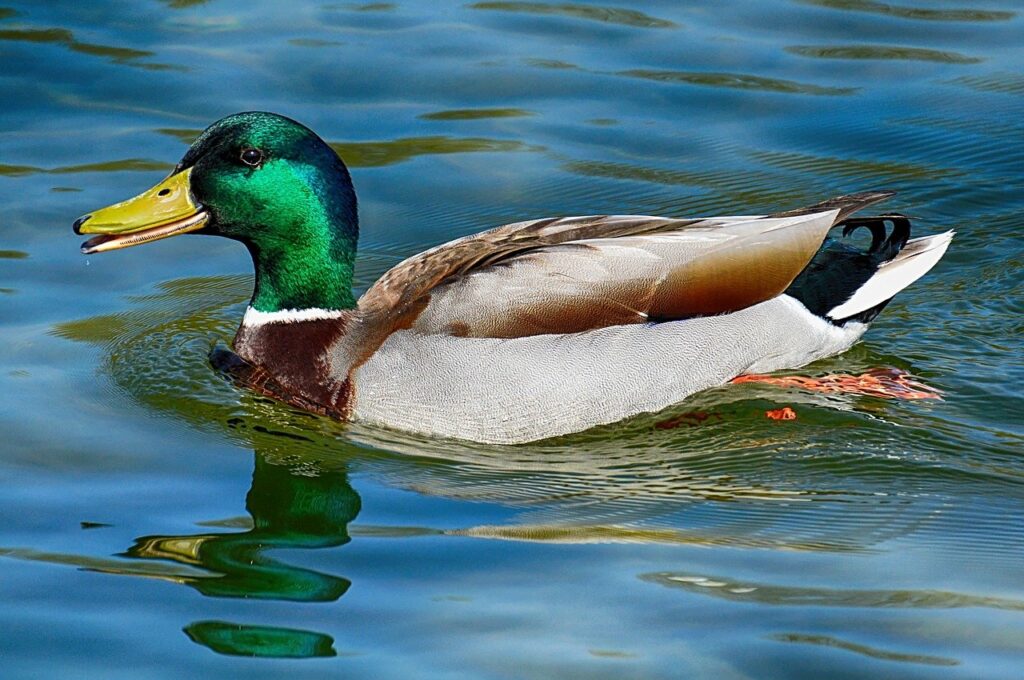 The water was clearer today because the men had come and removed all those horrible things. She’d heard it said they were from the Environmental Association, but she had no idea what that was. Sometimes, other people came as well. She’d heard them called volunteers, but she didn’t know what that meant either – all she knew was that when they appeared, the pond became cleaner, and her life became easier.
The duck finished feeding and paddled over to the far end of the pond where the reed beds grew. Soon it would be time to start building a nest in the reeds.
There never used to be reed beds. She remembered when the pond was simply a round hole in the land without these wetland areas around the edges. It may not seem like much of a change, but it had a major effect on her life when the wetlands appeared. The water no longer turned slimy and foul-smelling several times a year.
There had been other changes too- trees appeared near the pond, and fences around nearly all the edges. It was the Environmental Association again. She had seen men and women in oilskin clothes digging by the water for days at a time, piling up mud in some places, scooping it out and flattening it in others, until there were slopes and islands in the reeds which were much more like a wild place where she might have chosen to live.
The fences made it much safer for the ducklings. She remembered her own mother warning her not to ‘go on the road’ and pointing when a bird did that. There were big, noisy shapes rushing past at great speed, and humans waving their arms at the bird and shouting. It looked very frightening, so she was pleased that she had always been able to keep her own ducklings far away from there, behind a fence and a stretch of reeds. Last year she had successfully raised a brood of eight.
So this year’s brood should be well protected, as long as none of the human visitors to the park came tramping over the wetland area with rubber boots and a dog, which had happened a few times in the past. Eggs and chicks were very vulnerable, and nesting ducks were easily disturbed.
Settling down, she scanned the sky wondering how much longer it would be before her mate arrived. He’d been gone a long time, but she knew he was wise to all dangers.
***
The mallard drake had spent the winter far away from the town. On a distant heathland he had sometimes glimpsed a human being pointing a weapon at ducks and other birds as they flew overhead, sometimes bringing them down with a shattering noise. There were far fewer ducks here than in the park where he liked to go every Spring, to raise his family. But this was a lovely wilderness area, and such places were becoming hard to find.
If only those humans would leave them alone, he might think about bringing his partner here to breed, and there would be more ducks in the wild places they used to call their own. The pond where his partner lived was a sanctuary, and it was the behaviour of the humans who looked after it which made the difference.
Now he was coming home. He skimmed across the rooftops, heading for the patch of water where his mate was waiting for him. He skate-landed on the water with a cry of greeting. She swam around him in a circle half-spreading her wings, and they began their mating dance. They were ready to start their new family.
Inspiration: I admire the Baffins Pond Association and the environmental work they do. We supported them by going to all their fetes and fundraising events. I think the work they have done over the years is great.
Image by Here and now from Pixabay
Linda Hilborne comes from London and came down south in 1981 to take a degree at Bishop Otter College in Chichester. Since then, she has lived in Portsmouth and has most recently worked in adult education. In 2014 Linda started writing as a serious pursuit and studied with various creative writing groups. She has self-published eleven novellas and short story collections in the occult and visionary fiction genre, under two pen names. These are available free online. Linda also writes flash fiction and poems, and enjoys performing them at Spoken Word events.