

Fluke Prints
by Helen Salsbury
‘I will carry you,’ Kate says. The inevitable offer.
How is it possible to insist on dragging yourself up a flight of stairs, using only your arms, when your companion is so set on being heroic?
‘You don’t want to be lugging a dead weight around,’ Esme says.
‘Don’t I?’ Kate says. She squats, in a perfect show of disciplined muscles, to give Esme that intense look: challenging, defiant.
The deeper significance is not lost on either of them. But Esme is not going to have that conversation again. ‘Not today,’ she says. ‘I want to look for dolphins and whales. Once we get home it will all be…’
Different? Difficult? Both of those.
If only they could have stayed in Santander, where the sea turned her legs into a tail as her arms ploughed through. Where she and Kate could drift slowly into each other on the tide.
Had it been a mistake to allow Kate to convince her that they should go on holiday? She’d held out for a while and then given in, saying, ‘As long as we go by ferry. I don’t want to fly, the earth’s damaged enough.’ Implicit between the two of them, the words she wouldn’t say aloud, like me.
The slow travel of the ferry had appealed to her. She’d imagined the whole holiday as a long, slow goodbye, a remembering of the good times they’d had. Hadn’t realised quite how much this would make her ache.
‘I can do it,’ she says, eyeing the stairs.
‘We both know you can. Your arms are stronger now than when we climbed the Matterhorn or hung off Stanage Edge in training. Isn’t that enough? Let me!’
Let her lift me one more time. Rest my head on that densely-muscled shoulder and feel the bouncing movement of her stride. Catch the scent of her. That new orange perfume she picked up in the Mercado de Artesanía; the inevitable tang of sweat which will always be part of her.
I can’t.
Esme locks her chair, reaches up and grasps the handrail, begins to haul the weight of her body forwards and up.
‘I need you to bring the chair.’
*
The voice of Maara over the tannoy, twenty-minutes ago, is what has summoned Esme to the top deck. His musical foreign accent, and those slight pauses to choose words. His invitation to ‘help search the sea’. She’d felt it mattered to him that people would come.
He’s easy to spot, tall and olive-skinned, with unruly dark hair and a bright blue ORCA tabard. He’s wearing binoculars round his neck, has a notebook under his arm.
Esme rolls up to the small crowd gathered around him and locks the wheels against the sea’s sway. She watches the children as they shift excitedly along the rails, already peering out. A girl with flyaway blonde hair is raised on tip-toes, hands clinging to the top rail, as if the extra height will make all the difference. Esme likes watching young children. She’s on the same level as them, there’s no crick in her neck from always looking up.
Further along the deck, there are people working out on the outdoor gym equipment and one lone jogger running small, constricted circuits.
A young boy, azure-blue eyes made startling by the sun, comes and leans against Esme. ‘Why are you in this chair?’
‘A rope failed to hold when I was climbing a cliff.’
Actually, two metal pitons came out simultaneously, because the rock she’d chosen to wedge them in had splintered; a flaw somewhere deep inside.
‘Can’t you walk?’
His mother spots what’s happening and apologises, but Esme doesn’t mind. It’s far easier to engage with children. She wants to say this to the mother. But can’t.
‘It’s fine.’
And actually, it’s more than fine. This is a friendly crowd. People talk to her, rather than to her chair or over her head to Kate. And Maara, the marine conservationist talking about dolphins and whales, is fascinating. So many facts; so much enthusiasm. His passion gives her a sense of purpose. They aren’t just doing this because it’s something fun that the ferry company has laid on for entertainment. Any data collected will make a difference.
‘We need to know about them to protect them,’ Maara says.
Behind her on the white-metal wall there’s a picture of all the different dolphins, porpoises and whales they might see as they cross the Bay of Biscay. It’s a special place. The sea bed has different depths: whales in the deeper distance, dolphins up close. Dolphins like to ride the bow waves. Whereas whales, well at the moment maybe she’s more of a whale. Wanting to keep her distance, to stay where its safe, where she’s got deep water and not too much attention.
*
When Kate had proposed, while Esme was still in her hospital bed, she’d closed her eyes against her entreating look. ‘Stop being heroic.’
‘I don’t want to let go of what we had,’ Kate said.
‘Me neither,’ Esme had admitted. ‘But I’d slow you down. You’d come to resent it. You’d try not to, or you’d go off anyway and I’d miss you too much, and then I’d be funny when you got back. And we’d both try not to show any of this and it would slowly sap what we had.’
‘It doesn’t have to be like that!’
‘Doesn’t it?’
Kate had rallied. ‘Come on, I could be marrying a future Olympian.’
‘Paralympian!’
The image of the two of them training side-by-side, the way they always had, found its way into her head. Holding each other’s shoulders, torso, legs, to provide resistance. Doing reps, turn-and-turn around. Sweat dripping from one to the other, as they pushed each other harder and harder in pursuit of their joint goals.
Kate had embellished the idea, intent on painting a future they could share: the crowd roaring, herself as proud wife, beaming away. ‘You’d be famous!’
But something in Esme had changed. She no longer wanted to get to the top of every peak, no longer wanted to grab always at the next victory. She had no will left for the fight. Or perhaps she was saving that will for the day-to-day struggle of navigating this changed world, where pretty much everything had become an obstacle.
*
Searching the sea proved simple: you could watch for signs, fluke prints and hovering birds, and other indications of something happening below the surface, with its rippling muscular vastness which rolled on and on. But really all you needed to do was keep your eyes open.
At first Kate sat talking away beside her, valiantly ignoring the outdoor gym equipment bolted to the deck, and then she fell silent, leaning forwards to rake the sea with her gaze, scanning it back and forward. A quick intake of breath and then a,‘No. It’s nothing,’ and then sometime later a muttered, ‘Come on!’
She’s striving for a memorable experience to bind us together, Esme thought. She too fears that we will unravel, even though she’ll never be the one to say it.
Heroic. She’d have carried me back from enemy lines, if we’d been in a war. She’d have carried me down that mountain, if it hadn’t been better to leave me for the medics.
I’ll always love you, she thinks, as inevitably Kate starts to shift, her restlessness never long in coming.
‘Go on,’ Esme says, ‘go work out. I’ll be here.’
‘I didn’t –’
‘You did. I saw you looking across at the gym equipment. It’s okay. I’m quite happy here.’
‘If you’re sure.’
Esme’s hand over the knuckles of Kate’s fist. ‘Sure, I’m sure.’
A quick grin, a dropped kiss on her cheek, and that bounding energy beside her is off to find its outlet.
Will we survive? She hadn’t thought so, and yet something Maara said comes back to her, about the dolphins shifting off course, about sightings registered in the Outer Hebrides. Adapting to the changes in their environment; just as we are adapting to ours.
It’s easier, somehow, out here. The thoughts in her head are more philosophical, less dazed. What Maara had said about volunteering, about possibilities, starts to tug at her attention. Perhaps she too could ride the waves helping to protect something.
She wonders what his story is, although it’s not one he’s likely to tell easily on a ferry. There’s a guarded sadness in his eyes, an underlying weariness. And yet, watching him now, with the children clustered around him, it’s clear that he has found healing and purpose in his role.
All these tiny fragments, rising like bubbles, lifting her spirits, giving her hope. The rise and fall of the deck, the water: grey and green, a drift of deep red seaweed, a white bird settling down. Her gaze widens, softens.
And it’s when she’s no longer looking, just keeping her gaze open to absorb the sea, that it happens. So fast that she’s screaming out before she realises. ‘There! There!’
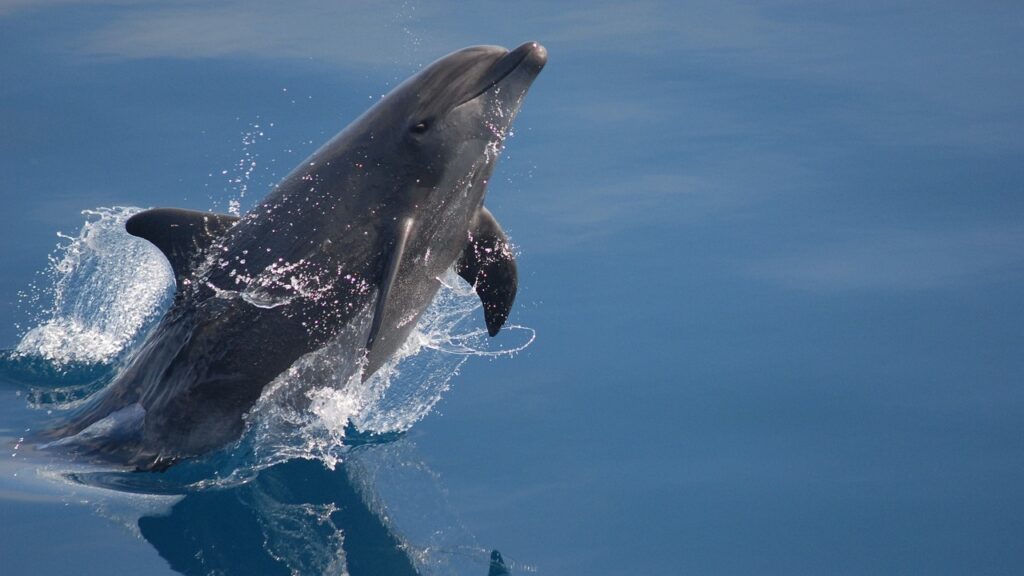
She’s pointing, and people are turning to look. There’s a splash and it’s already gone. But she’s seen it. A dolphin, leaping up into the sky, something so beautiful and miraculous in that quick arc of back, that total defiance of gravity.
‘The earth’s damaged,’ she’d said, when she’d argued for this slower trip, and she’d swallowed down the bitter like me. But she hadn’t really understood until now, until this moment, that even damaged the earth was still beautiful, still vital, still everything!
She lifts her gaze and sees Kate, paused on the slalom skier.
‘Did you see it?’ she mouths.
A tiny head shake, and then, ‘Not this time.’ The words are clearly readable on those lips, those beautiful lips.
Inspiration: A real life encounter with a marine conservationist from ORCA, on our Spain to Portsmouth ferry, transformed our journey. When I wasn’t up on deck helping to watch for dolphins and whales, I was scribbling down details and searching for a seed idea for my story. Realising that the ferry lift only went as far as the 9th floor provided the spark I needed. I’ve wanted to write about what it’s like to be in a wheelchair ever since I spent time in one while recovering from CFS/ME. With thanks to Natasha Jones, Marine Conservationist, ORCA, for making the journey so magical.
Image by David Mark from Pixabay
Helen Salsbury’s debut novel Sometimes When I Sleep is a contemporary coming of age novel, influenced by late 18th Century Gothic literature. Helen is a short story writer, spoken word performer and community journalist, who has been longlisted for the Mslexia novel competition and shortlisted for the Impress Prize for New Writers. Her Portsmouth-based Writing Edward King short story, Persephone in Winter, was recently republished by Fairlight Books.