

An Acceptable Alternative
by Jane Andreoli
Christmas shouldn’t have been a contest, but it always was. My gifts, wrapped in supermarket paper looked unbelievably shoddy beside Barbara’s sumptuous offerings. There was so much ribbon, holly, tinsel, poinsettia, bells, and reindeers that you could barely see the wrapping paper, but when you did, your fingers caressed the quality.
It tore richly, with a sound like the discreet cough of a well-trained butler: soft, and baritone. My cheap shiny paper crinkled where I had been clumsy with the Sellotape and tore in quick soprano sneezes.
We were sitting, the five of us, in Barbara’s sumptuous living room. It was richly feminine, with swagged curtains, floral wallpaper, thick pile carpet, and wall lights above tastefully gold-framed watercolours. Her husband Matthew, tall, spare, and lightly Old Spiced, may have preferred something different, but a lifetime in the army made him adaptable. He was used to making camp in foreign territory.
Their daughter Moira sat on an oversized pouffe. The thick chenille might have been the splintered boards of a ducking stool, the way she clenched her hands on its edge. Their granddaughter Pandora lounged on the sofa. Her black jeans and purple boots were at least clean. That was her sole concession to the occasion. No – not her sole concession. I bit back a snort of laughter as I realised why there was so much frost in the air. It was the earrings. Barbara always presented close friends and female relatives with pearl stud earrings. She felt they were the ultimate in discreet good taste and was apt to ask why they weren’t being worn as they would go so well with whatever one’s outfit happened to be. Giving in was easier than constantly making excuses. I was wearing mine, and Moira was wearing hers. Now I saw that Pandora had hers on too: one through an eyebrow and the other through her nose.
The giving of gifts was proceeding well. We had unwrapped almost everything. Finally, Pandora produced a small carrier bag from behind the pouffe with a defiant glare at her mother. She emptied it out and a new smell filtered through the opulent scents of pine, sandalwood and the red candles called ‘Winter Berries’. This smell was greasy and cheap. Fish and chips? No, they didn’t wrap them in it these days, but the smell of newsprint ink still made my mouth water in reminiscence.
Pandora’s gifts, wrapped in newspaper and tied with string – since she refused to waste plastic by using Sellotape – sat in a grey, ugly heap. The very poverty and pathos of these offerings was accusatory and shaming. In the thick embarrassed hush that followed, I prayed that Barbara would keep her temper. Reaching out, I took the small parcel that had my name on it, thanked Pandora and began to unwrap.
‘Oh, how lovely! Scented soap! My favourite!’
I was hamming it up and I knew it, and so did everyone else. I was the only performer on a silent stage. I gabbled on desperately about how very nice it was to have a bit of luxury when I washed my hands, until Barbara’s voice cut across mine like a flamethrower.
‘So, Pandora. Your grandfather and I welcome you to our home and this is how you respect our hospitality.’
That tone would have reduced a subaltern’s wife to ashes, but Pandora’s chin went up, and battle commenced.
‘Did you know that fifty thousand trees are cut down every year to make wrapping paper?’ Pandora said. ‘Do you care that over two million pounds of it end up in landfill every year? Do you realise that all that extra stuff –’ here she kicked the heap of discarded decorations that had been stripped off Barbara’s parcels ‘– will degrade into microplastics and pollute the earth for God knows how many generations to come? Do you even realise there’s a global warming crisis? I found a price tag in the bin. £14.00 for two metres of luxury gift wrap! You might have money to burn, but I’m on a restricted income. Have you thought about that?’
‘How dare you look in bins!’ shouted Barbara. ‘And as for being on a restricted income, what do you expect when you’ve wasted your qualifications working for Greenpeace instead of getting a proper job?’
I looked from Barbara to Pandora: saw the same flush on both faces, noted the furrowed eyebrows and flared nostrils that were so alike, and knew that neither one would ever back down. It simply wasn’t in their natures. Somehow, we had to get through this Christmas, and find an acceptable alternative for them both.
As Moira wept into her gin, Matthew and I retreated into the kitchen with a bottle of Shiraz to take as long as we dared over the washing up.
In the months that followed, I devoted myself to bridge building. I knew that Barbara’s perpetual habit of put-downs and corrective snubs could be hard to cope with, but I knew that deep down her heart was in the right place. Pandora saw the finished woman. She didn’t see the frightened young army wife, short of time and money, but forced to conform to all the dress requirements that went with rank. She didn’t see the nomadic lifestyle from one army base to another, never able to put down roots and create a proper home. Pandora saw the over-stuffed, over-heated and ostentatious home of her grandparents as an affront to the leaner lifestyle that was needed to save the planet. I saw the same things and explained that they were a giant padded blanket pulled over the head of a little girl who didn’t want to be taken away from her familiar safe place any more.
Barbara saw Pandora as rude, rebellious, out of control and clearly the product of Moira’s inadequate parenting. I wondered aloud how fast she had had to grow up, when her father was killed in that car accident. I reminded Barbara of how she and Matthew had been abroad, and Moira had gone to pieces, and Pandora had stepped up to sort out finances, funeral arrangements, and all sorts of things that a fifteen-year-old should not have had to face alone. Barbara wondered aloud where Pandora had got her temper from. I smiled.
‘From you, of course,’ I said.
It was the W.I. that gave me the opportunity to provide the perfect solution. Barbara and I had been members for many years. I enjoyed my work on the committee, booking speakers and craft workshops. It took me some time to find a teacher of this particular craft, and even longer to persuade the committee to pay her fee and high travelling expenses, but in the end they agreed.
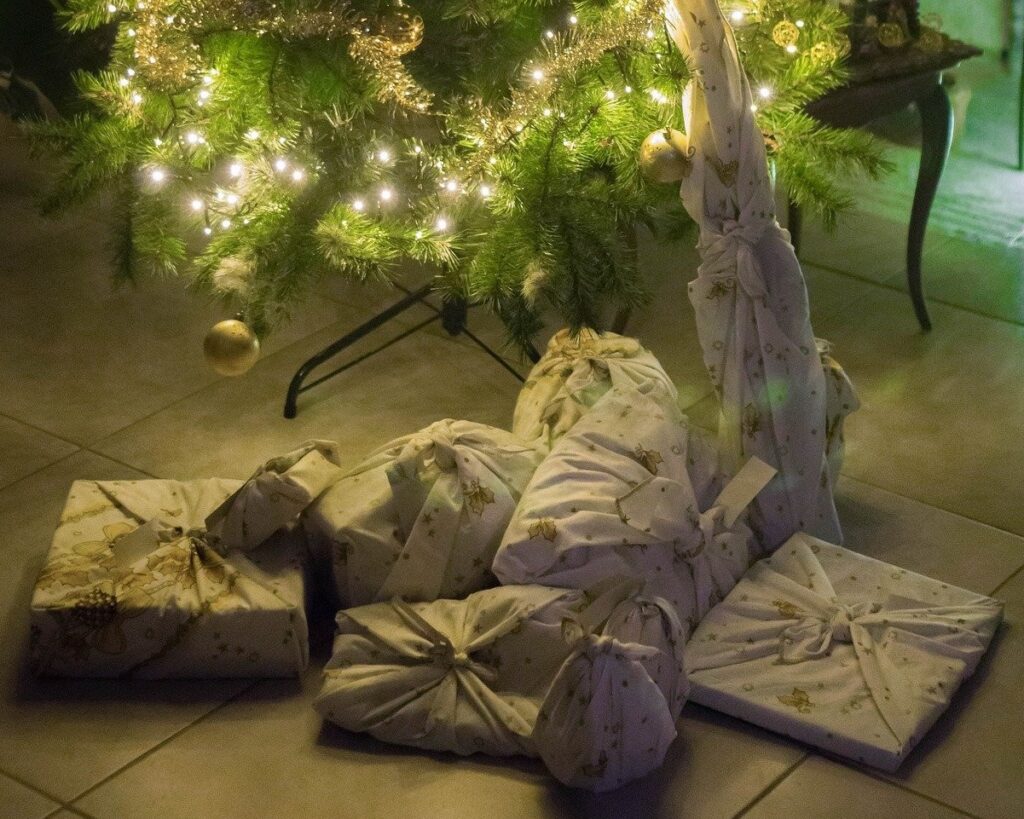
The woman who arrived to instruct us in the ancient skills of Furoshiki had learned the craft from her Japanese grandmother. Squares of cloth were folded and knotted to form all kinds of bags and carrying cases, and to wrap gifts. We got out the selection of headscarves and hankies that we had been instructed to bring, and spent a happy afternoon wrapping books, boxes, and even bottles of wine, then turning larger squares into unusual shoulder bags to carry home our parcels. I watched Barbara’s intense concentration and sat back contented.
The year turned. Birthdays, anniversaries, and Easter came and went, and were celebrated with the usual cards and gifts. I noticed changes in Barbara’s offerings. Her greeting cards were made from recycled paper. The French soaps that she gave me for my birthday came tied in small squares of sprigged muslin and tucked into a recycled envelope.
The days became shorter, until with a feeling of déjà vu, I arrived to spend Christmas with Barbara and Matthew once more. The tree sparkled as usual. I noticed that Barbara had re-used last year’s decorations. Her usual habit was to throw everything away on Twelfth Night and buy new.
The pile of gifts underneath it was richly coloured. Barbara had recycled her old Hermes scarves in an orgy of Furoshiki, considerably adding to the value of the gift inside. Pandora’s were tied with a variety of brightly coloured cotton squares, probably acquired from charity shops. Even Moira had had a go, though her knots were not very well placed, as Barbara was quick to point out.
Pandora blogs about the technique, and Barbara now teaches evening classes. Moira’s gin consumption has gone down considerably, and the three women have even gone out together on occasional shopping expeditions.
As for me, I didn’t care that they both thought it was their own idea, despite the workshop I’d arranged for Barbara and the book about the technique I’d sent Pandora for her birthday. I just leaned back in Barbara’s comfortable chair, winked at Matthew as he handed me a large sherry, and ate the superb mince pies he set down beside me.
Grandmother and granddaughter were now allies. Trees, faces and relationships had been saved. The new year landfill would be a little lower.
Christmas was rescued.
Inspiration: Every generation steps forward into the unknown and makes mistakes. What we need to save the planet is communication, forgiveness, and acceptable alternatives. My story shows one small example of the many alternatives that are out there waiting to be found.
Image by AuroreLEBECQ from Pixabay
Jane Andreoli loves the natural world, and spends a lot of time outdoors, watching things grow. Being retired, she has time to connect with what’s happening in her garden, and this is a major inspiration for her writing.