

Eastney – A Crossing Place
From Esplanade to Edgelands
by Rachel Birchley
The tide is coming in, reclaiming the land. A place that exists twice each day, ruled by the moon, is a space where possibility lives.
Louise Kenward (2021).
I am walking east, following the Solent coastline’s jagged edges to the city’s furthermost point, away from the hubbub of South Parade Pier and the shingle below overspilling people. Legs outstretched, arms spread like sand angels, still as the dead but for the steady rise and fall of their chests under the sun’s unwavering glare. Away from the omnipresent coffee and fast food stands, ice-cream vans, discarded food cartons and wrappers and cans. Away from the smells: the salty fusions of seaweed and chips and deep-fried chicken, ice cream and sunscreen and sweat. Away from the screech of gulls swooping for a dropped chip, battered crumbs. Away from the pounding of feet, the soft clicks of dogs’ paws along the promenade, the skid of tyres along the roadside, the cacophony of voices and music from passing cars and bikes, the bustle of the beach.
But venture further along the wide, flat concrete of the promenade – past Canoe Lake and the Rose Gardens of Lump’s Fort, the sweep of Gunner’s Row, part of the old Royal Marine barracks – there is a subtle, yet tangible shift in the air, a crossing of an invisible but discernible boundary. A slowing of pace, a calming, to an-almost quietude. The esplanade stretches out, out for what at first seems like miles. But the number of walkers, joggers and cyclists drops significantly, any traffic passes slowly. The sea seems to distend, swelling, entering a new phase, its colours morphing from a murk of mud brown and grey-blue into a purer, cleaner turquoise. Along the beach and verge-sides, crops of sea kale and sea radish start to sprout. Yellow charlock mustard buds flourish, flanked by fennel and the crimson of red valerian.
I step off the promenade and onto the shingle, feeling the uneven surface of pebbles and shells and stones shift under my feet. The weight of it makes it more difficult to walk and I drop my pace a little.
As I walk on, the sea-scrub thickens, clusters of it spaced closer, denser. Adjacent, across the now-empty road, this is mirrored in the tangle of brushwood and overgrown hedgerows. There is hardly anybody around and a sense of wild is seeping in. Derelict ex-MOD buildings loom from behind, Chernobylesque. There are graffitied, windowless outhouses and lookout points, rusted Portakabins, piles of rubble. From the rust-brick edifice of a building, a slogan in ivory is daubed: ‘HAVEN’. And even from the cracked windows, the rubble and debris-strewn grounds, there is a calm, a lambency. Hope.
Gulls shriek, circling overhead. Pigeons huddle on a wood-rotted pane, peering down through a soot-smeared window crack. Clusters of cabbage-like sea kale sprout from patchy, greening land. Sun-burnished mustard flowers defiantly raise yellow heads, coruscant, saluting the sky from the barrenness of their surroundings, and looking down at the silver glint of the sea below. This is another crossing place. Where new life springs from ruins and decay, greenness from grey. Renewal and rejuvenation.
Beneath this embankment path, following the rusted, barb-wire grilles of the former military land, a few sunbathers appear, dots in the sand. This part of the beach is a recognised nudist beach, though you can easily pass through. Wind chill has lowered the temperature but several people, naked, lie on towels, lean back against slabs. The embankment slopes gently uphill, further away from the beach, above a seawall of mossy rocks and seaweed-clung boulders, great shingle-encrusted slabs. Groynes stretch out into the sea, the incoming tide submerging them briefly before ebbing back. Here, the sea seems wilder too, more free-flowing, clearer, less polluted, the colours pure, true, shifting into one another. The ecru of the mud-sunken sediment at the bottom merges with jade, turquoise, a deeper, opaquer blue-black, like squid ink. The foamy wave-crests surge and retreat. It is hypnotic. Closer to the edge of the seawall, tiny rivulets of fresh, clear water pool into the rocks’ cracks and crevices, clinging, shining like morning dew, to the seaweed-carpeted slabs, permeating, softening the wood of the groynes.
Ahead, the path halts abruptly, the wall a steep drop down. The only feasible way to proceed is to clamber down onto the mossy steps. I look down. They appear almost radioactive, a carpet of fluorescent green. The tide is rushing in with greater urgency, relentless. Splashes of fresh seawater spill over the slippery rocks, foam sending spray into the air, bringing forth a tang of seaweed and salt. I feel the droplets against my face, dampening my hair. With each onrush, the groynes disappear under great foamy crests.
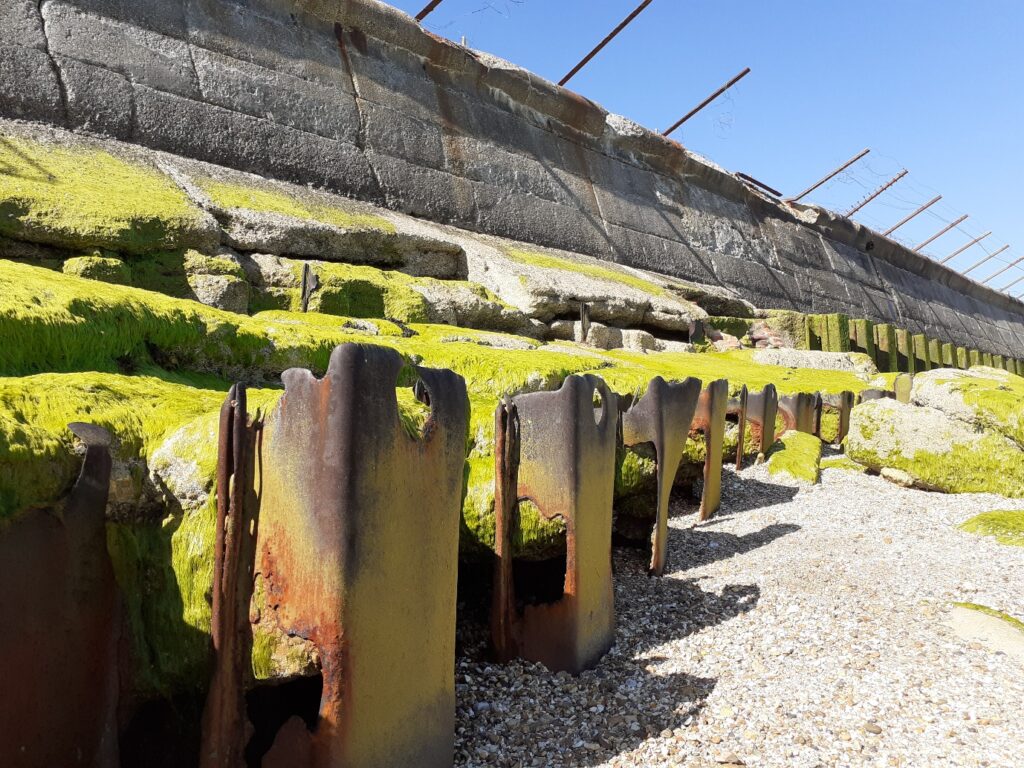
I am poised, my tread tentative, careful as I step onto the green expanse of sea-rubble, almost entirely moss-carpeted. The sharp tang of salt fizzles, then dissipates, seeping down into the rocks, absorbed by its blanket – a tapestry of living, breathing organisms. If Oz was a sea kingdom, I could be walking through its Emerald City. Each tendril of seaweed, lichen, every algae spore undulates and sways under the soft lick of saltwater that rolls over them. It is as though they are bowing to Poseidon himself. For now, the tide is low, its roll gentle, a lullaby hush. White foam-crests spit softly over the rocks and the seaweed-caressed iron bolsters that line the bottom of the shoreline, once part of an imposing south coast fortification, the old Fort Cumberland, constructed in the mid-eighteenth century.
At my feet the shingle reappears as I cross the last of the boulders and hop down onto a flatter shore which veers slightly left, revealing pockets of damp, rippled sand and rockpools made by the deep crevices between mossy, seaweed-clung slabs. In this inlet, thousands of shells and stones form another kind of sea-path strip – one that crunches underfoot as misshapen pebbles, flint nicks, whelks and limpet shells, sea-snail whorls, and hag-stones form a sea-tossed embankment. As I settle onto a dry slab, I notice the glint of sea glass under the shafts of sun which push through the thickening cloud-roll. In front of me, the sea stretches, swells, an oscillating mass. It extends beyond the granite-grey jut of Eastney Pier, pooling between its sturdy, symmetrical pilings, submerging the sea-worn, rusted-iron flanks of the old World War Two pier, less than a pebble-skim away. It curves around the shoreline’s C-shape as Eastney’s long, arched finger crooks a sculpted nail to be within touching distance of Hayling Island’s golden glimmer. I can make out the outlines of people walking, just across the bay. A looking-glass I could swim into. Instead, some five hundred metres away, a tiny ferry crossing stands, at the point where the two lands almost meet.
There are several others here, near me, in this inlet: two rowers, oars slicing the water with precision, an angler at the pier’s edge, weathered face a mask of concentration. A dog scuffles through the shingle, nose buried deep in sand, before chasing a thrown ball into the shallows. This place is not mine alone, but there is an aura of solitude, of solace about it. A deep calm, impelled by the hypnotic sedative of the sea.
I lower myself onto the beach, find a sandy drift, and stretch out. A sense of something unfurling, a loosening inside me. An unburdening. A flitting breeze brushes my arms, kisses the back of my neck. Sand-grains spill through my fingers. I think of an hourglass and despite the constant tide-flow – that old, true measure of time – somehow this place exists, I exist, unfettered by time, pulled towards nature by nature.
This is a space where I feel a mental rebalance, an emotional crossing of sorts. A place, ephemeral, yet eternal. A space I am drawn to again and again – a space at the edge of the land which exists in its own realm and one that beats inside my heart and lulls me to sleep in absentia. A place that should not occupy the same boundaries as a condensed, overcrowded city, where the concrete towers and identikit homes have replaced the meadows and farmland and hedgerows that once thrived. But I am infinitely glad that it does. And that there are other little wild places too, all over this island city, that are spreading, even flourishing. Urban meadows – wildflowers and saplings – have been planted on housing estate communal lawns, roadside verges and roundabouts. Tiny gardens have been fashioned in precinct squares, parks. Alley hedges brim with ivy garlands, the white, trumpet-mouths of bindweed, the lilac-pink of mallow. Crossing places, like this one, exist everywhere when you step into the landscape and look.
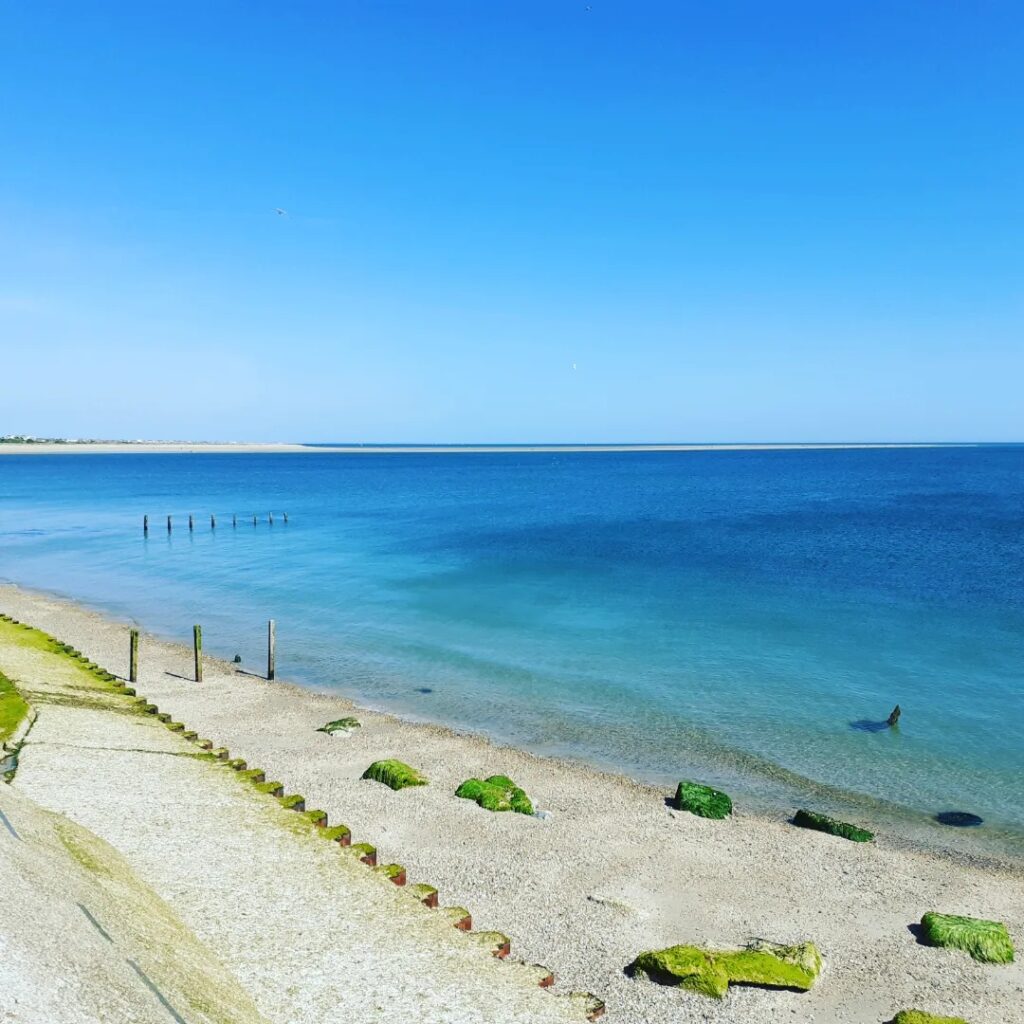
Inspiration: I am passionate about finding and celebrating the nature that flourishes on our doorsteps – and in the places we least expect: abandoned, derelict buildings, alleys, wasteland and at the edges of the urban spaces where we live. Eastney Point, a place where the land’s edge meets the sea, epitomises physical, mental and metaphorical crossings, but is also a special little haven of pure wildlife thriving in its own domain.
Photographs by Rachel Birchley
Rachel has recently completed a creative writing MA at Portsmouth University and hopes to begin a PhD in 2023. This piece is an extract from a chapter of the Portsmouth-based nature and urban landscape memoir she is currently writing. Rachel also writes poetry, short fiction and music reviews which have been published online and in anthologies.